 English
 русский
 Español
 Français
 عربى
عربى italiano
Multi-product thermal display cabinet
The multi-product thermal insulation display cabinet has various sizes, elegant appearance and unique design. It ad...



Refrigerated food display cabinets and heated food display cabinets serve opposite but equally important roles in commercial food service: refrigerated units hold perishable items such as dairy, deli meats, sushi, and desserts within a safe cold range, typically between 2°C and 8°C, while heated food display cabinets keep cooked and ready-to-eat food such as roasted meats, pastries, and hot deli items above the food-safety threshold of roughly 60°C to limit bacterial growth. The core distinction goes beyond temperature direction alone — it extends to the refrigeration or heating circuit, insulation strategy, glass configuration, and airflow design built into each cabinet type. Deciding between a refrigerated display cabinet, a heated display cabinet, or a combination unit depends on the product category being merchandised, the footfall pattern of the retail space, and the presentation goals of a bakery, supermarket, canteen, or catering business. This guide walks through the common cabinet types, their internal structure, typical application scenarios, a detailed side-by-side comparison, maintenance requirements, and answers to common sourcing questions, giving buyers, distributors, and foodservice operators the practical information needed to select the right commercial food display cabinet for their business.
Content
Both refrigerated and heated food display cabinets come in several configurations, each shaped by the food category it is meant to present and the amount of customer access it needs to allow. Below is a quick overview of the formats most commonly found in supermarkets, bakeries, delis, and catering operations.
An open-front, fan-assisted refrigerated cabinet with multiple shelves, commonly used for dairy, beverages, and packaged deli items in high-turnover supermarket aisles.
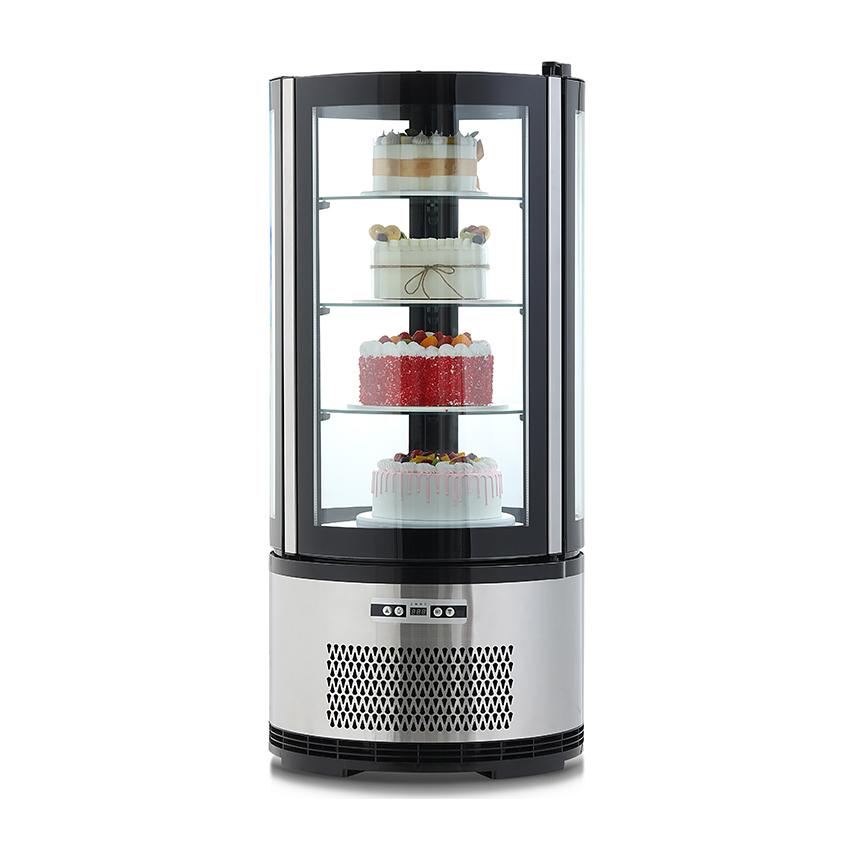
A curved-glass refrigerated cabinet, often static-cooled, designed to present cakes, pastries, and desserts with minimal visual obstruction for bakeries and cake shops.
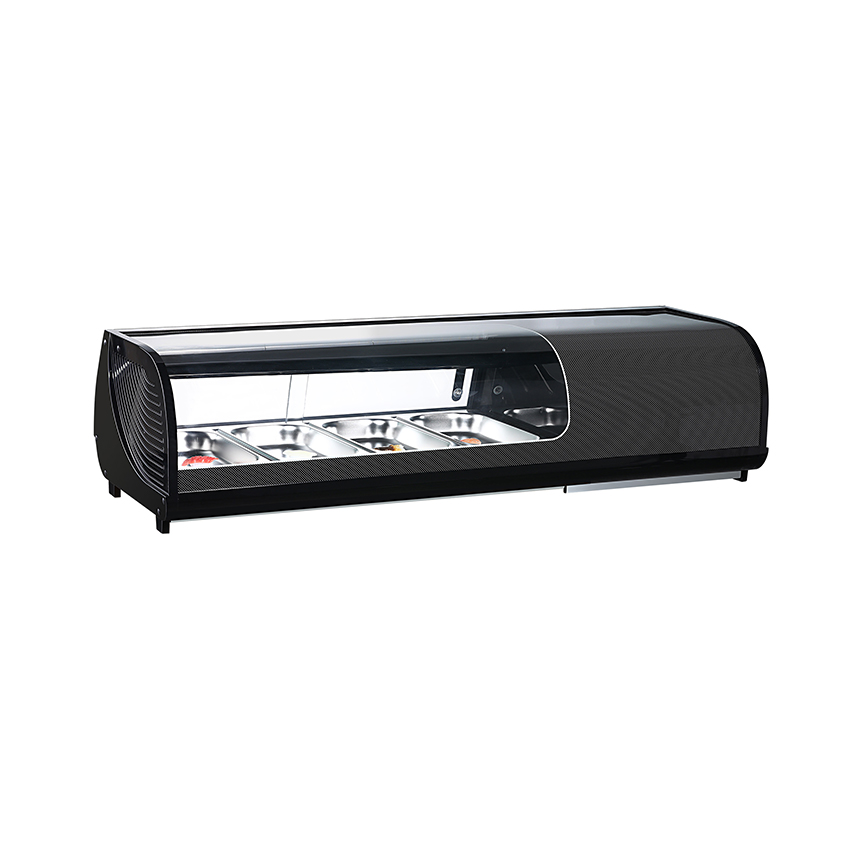
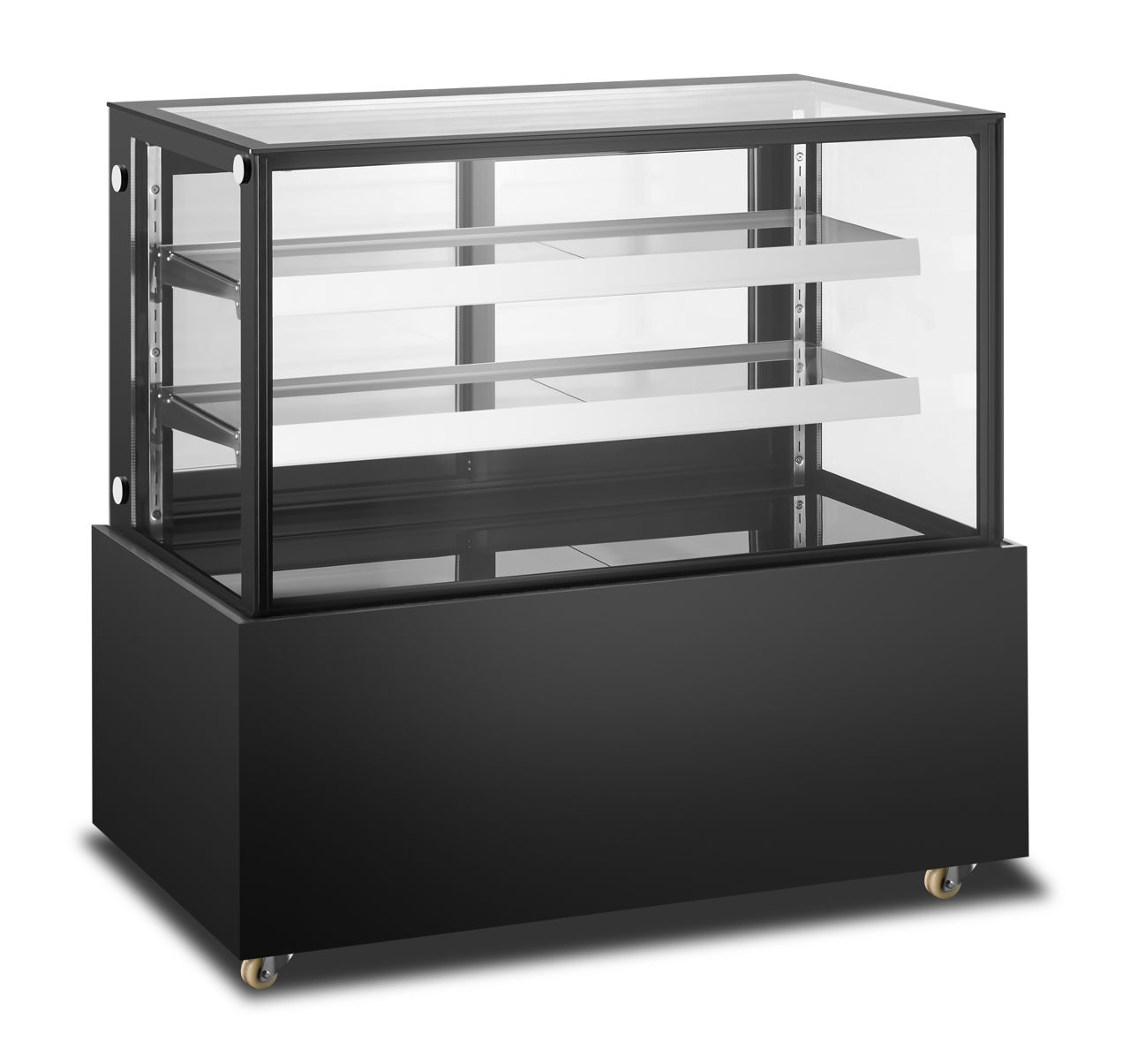
A front-service cabinet with flat glass and rear staff access, suited to deli meats, seafood, and prepared salads that need assisted rather than self-service handling.
A wet-heat display using a water bath beneath food pans to maintain consistent hot-holding temperatures for prepared dishes, common in buffet and catering settings.
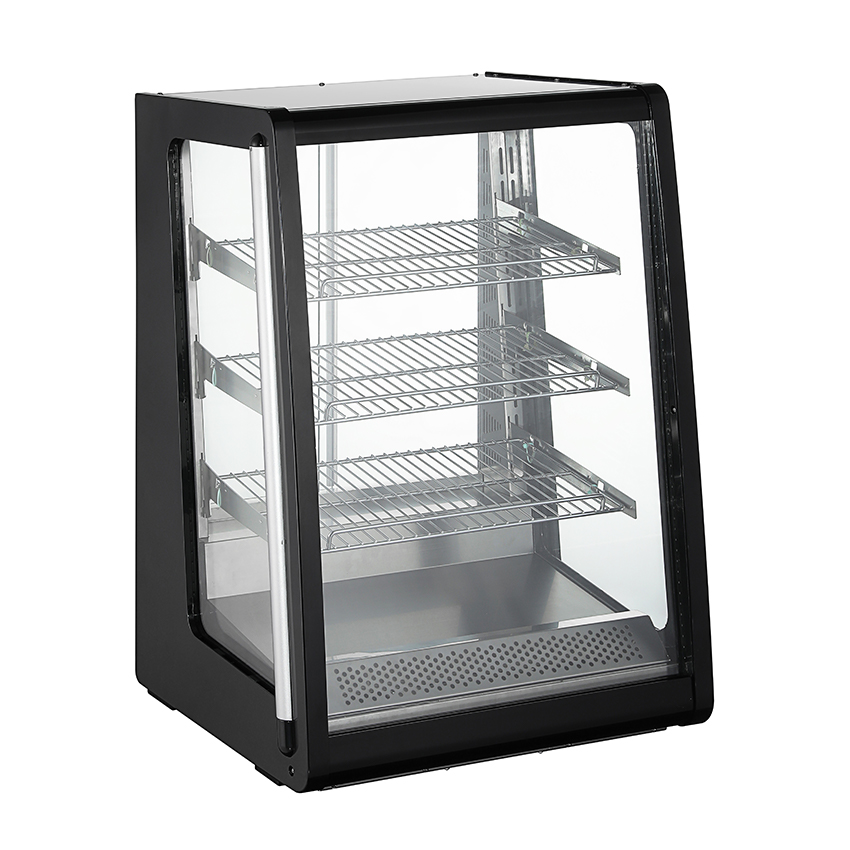
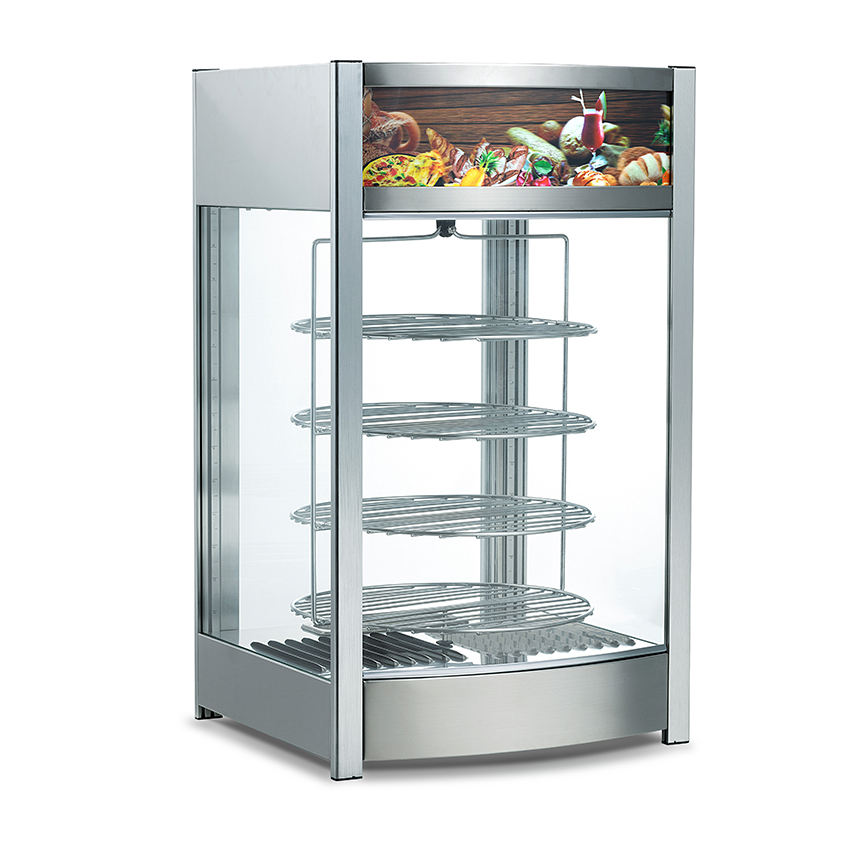
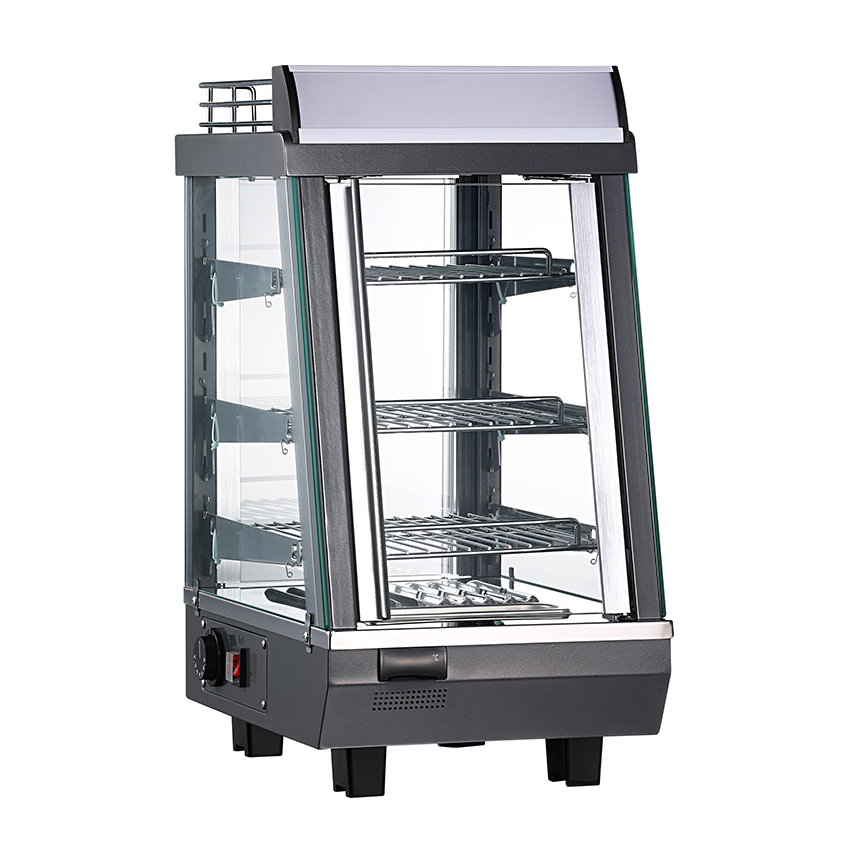
A dry-heat cabinet, often with a curved glass front, used to keep fried items, pastries, and bread warm and visually appealing without added moisture.
A dual-zone counter combining a refrigerated section and a heated section in one unit, useful where floor space is limited but a mixed hot-and-cold menu is required.
Retail and foodservice businesses deploy refrigerated and heated display cabinets across a wide range of channels, each with different merchandising priorities. Supermarkets and grocery stores tend to operate the largest number of cabinet units per site, spanning dairy, deli, and bakery sections. Bakeries and cake shops rely heavily on curved-glass display units to showcase both chilled and freshly baked products. Catering companies, hotels, and buffet-style restaurants often prioritize heated bain-marie counters for hot-holding prepared dishes. The chart below illustrates an approximate distribution of display cabinet demand across these common channels, based on general patterns observed in commercial foodservice equipment usage.
Supermarkets & Grocery 35% Bakeries & Cake Shops 30% Catering & Buffet 20% Convenience & Other 15%
As the chart illustrates, supermarkets and grocery stores represent the largest single channel for both refrigerated and heated display cabinets, reflecting the sheer variety of perishable and prepared food categories sold under one roof. Bakeries and cake shops follow closely, since visual merchandising through curved glass is central to how these businesses present chilled desserts alongside warm bread and pastries. Catering and buffet service operations make up a meaningful share as well, largely driven by demand for heated bain-marie counters that can hold multiple hot dishes throughout an event or meal service. The remaining share, grouped under convenience stores and other quick-service formats, tends to favor smaller, space-efficient cabinet configurations rather than large multi-deck units. This distribution pattern matters for manufacturers and suppliers because it shapes which cabinet sizes, glass configurations, and formats are produced in higher volumes. It also explains why many food display cabinet manufacturers maintain both refrigerated and heated product lines rather than specializing in only one, since a single supermarket or hotel client may need both types for different departments. For wholesalers planning inventory, understanding this channel mix can help prioritize which cabinet models to stock in greater quantity. It is worth noting that the exact proportions can vary considerably by region, local food culture, and the balance between grocery retail and foodservice dining in a given market. In markets with a strong bakery culture, for example, the bakery and cake shop segment may represent an even larger share than shown here. Despite regional variation, the general pattern of supermarkets and bakeries leading demand, followed by catering and smaller-format channels, tends to hold across many commercial food display cabinet markets. Recognizing where a particular business fits within this broader channel picture can help buyers benchmark their own equipment needs against common industry practice rather than starting from scratch.
Refrigerated and heated food display cabinets are engineered around opposite temperature goals, so matching the cabinet type to the specific food category is the first and most important selection step.
A refrigerated food display cabinet relies on a vapor-compression refrigeration circuit: a compressor pressurizes refrigerant, a condenser releases heat outside the display area, an expansion device drops the refrigerant's pressure, and an evaporator absorbs heat from inside the cabinet, cooling the display space. Fan-assisted models circulate this cooled air across shelves for even temperature distribution, while static-cooled models rely on natural convection, which is often preferred for delicate bakery items sensitive to airflow. A heated food display cabinet, by contrast, uses either an electric heating element or a water bath (bain-marie) to add heat, paired with a thermostatic controller that maintains the set holding temperature. The table below breaks down the core components typically found inside each cabinet type.
Refrigerated Cabinet Core Components
|
Heated Cabinet Core Components
|
Understanding how a refrigerated display cabinet behaves over a full operating day helps explain why certain structural features, such as fan-assisted airflow and insulated glass, matter so much. Internal temperature inside a well-functioning refrigerated cabinet should stay within a relatively narrow band even as store staff open doors, restock shelves, and customers browse nearby. Brief temperature rises are normal during high-activity periods, but a properly designed cabinet should recover quickly once the disturbance passes. The chart below traces an illustrative 24-hour internal temperature pattern for a refrigerated multi-deck display cabinet operating in a typical retail environment. The pattern highlights both the stable baseline temperature and the short-term spikes associated with restocking activity.
The line chart shows the internal temperature holding close to a baseline of around 4°C for most of the day, which sits comfortably within the commonly recommended 2°C to 8°C range for chilled perishable food. Two noticeable spikes appear in the pattern, corresponding to periods of heavier restocking activity when the cabinet's open front experiences more frequent air exchange with the surrounding room. After each spike, the temperature line returns to baseline relatively quickly, illustrating the recovery capability that a well-insulated cabinet with adequate refrigeration capacity should demonstrate. This recovery speed depends heavily on compressor sizing, evaporator coil condition, and whether the airflow design is fan-assisted or purely static, which is why the structural components described above directly influence real-world temperature performance. If the spikes in an actual cabinet were larger or the recovery time noticeably longer than what is shown here, it would typically indicate a maintenance issue such as a blocked condenser coil, a worn door gasket, or an overloaded shelf blocking internal airflow. Retail staff can use a similar temperature log, whether from a built-in digital display or an external data logger, to monitor their own cabinets against this kind of expected pattern. Consistent temperature monitoring is also a practical way to catch early signs of compressor wear before a full breakdown occurs during business hours. For food-safety purposes, sustained deviation above the safe range for an extended period, rather than a brief spike during restocking, is generally the more serious concern. Many commercial kitchens set up temperature alerts so that any prolonged excursion outside the safe band triggers a prompt check by staff. Comparing actual performance data against an illustrative baseline pattern like this one gives store managers a useful reference point when evaluating whether a refrigerated display cabinet is operating as intended.
The vapor-compression cooling circuit in refrigerated cabinets and the electric or water-bath heating system in heated cabinets are fundamentally different mechanisms, which is why the two cabinet types cannot be interchanged for opposite food-safety purposes.
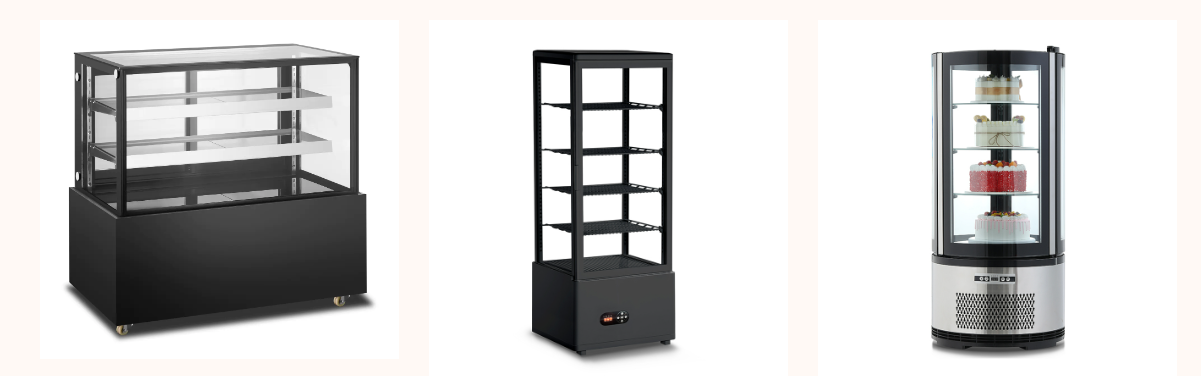
Supermarkets and grocery stores typically run refrigerated multi-deck chillers and heated rotisserie sections side by side to cover both packaged and freshly prepared food. Bakeries and cake shops lean on curved-glass refrigerated cake showcases alongside heated cabinets for bread and pastries fresh out of the oven. Catering companies, hotels, and buffet-style restaurants often prioritize heated bain-marie counters for hot-holding prepared dishes, paired with chilled sections for salads and cold appetizers. Canteens and quick-service restaurants frequently choose combination hot/cold counters to make efficient use of limited counter space during peak meal periods. Convenience stores tend to favor compact refrigerated grab-and-go cabinets alongside small heated snack cabinets near the checkout area.
When narrowing down a specific model, buyers generally work through a consistent set of selection questions before contacting a food display cabinet manufacturer or supplier:
Selecting between a refrigerated and a heated display cabinet often comes down to weighing several performance dimensions against each other rather than looking at a single specification. Temperature control precision, visual merchandising impact, product freshness or hot-holding duration, energy efficiency, and structural simplicity all factor into a buyer's decision in different ways depending on the business. Some of these dimensions matter more for a bakery focused on visual presentation, while others matter more for a canteen focused on operating cost. The radar chart below compares an illustrative refrigerated cabinet profile against an illustrative heated cabinet profile across these five dimensions on a simple relative scale. Reading the two overlapping shapes side by side can help clarify where each cabinet type tends to have a structural advantage.
Refrigerated Cabinet (illustrative) Heated Cabinet (illustrative)
On the freshness and hot-holding duration dimension, the refrigerated cabinet profile extends further outward, reflecting the reality that chilled storage generally supports a longer safe holding period for perishable food than hot-holding does for prepared dishes. Both cabinet types score similarly on visual merchandising impact, since curved glass and well-lit display shelving are available options for refrigerated and heated units alike. The heated cabinet profile shows a slight advantage on structural simplicity in this illustrative comparison, largely because some heated display models rely on simpler resistive heating elements rather than a full vapor-compression refrigeration circuit. Temperature control precision favors the refrigerated cabinet marginally in this example, reflecting the fine-grained thermostatic control commonly built into compressor-based systems, though well-built heated cabinets can also achieve tight thermostatic control. Energy efficiency is shown as roughly comparable between the two types in this illustration, since actual energy use depends heavily on cabinet size, insulation quality, and how often doors or open fronts allow conditioned air to escape. It is important to treat this radar chart as an illustrative comparison rather than a precise technical benchmark, since real-world performance varies by manufacturer, model, and installation conditions. Buyers evaluating specific units should request manufacturer specification sheets for actual temperature tolerance, insulation ratings, and rated power consumption rather than relying on general comparisons alone. A radar-style comparison like this one can still be a useful starting point for narrowing down which cabinet type aligns with a business's top priorities. A bakery prioritizing dessert freshness over multiple display hours, for example, may weight the freshness dimension more heavily than a canteen focused primarily on operating cost. Ultimately, no single cabinet type scores highest across every dimension, which is consistent with the idea that refrigerated and heated display cabinets are purpose-built tools rather than universally interchangeable equipment.
Choosing between a refrigerated cabinet, a heated cabinet, or a combination counter depends primarily on the food category, available space, and footfall pattern of the specific retail or foodservice environment.
The table below summarizes the main structural and functional differences between refrigerated and heated food display cabinets across the dimensions most relevant to buyers.
| Dimension | Refrigerated Display Cabinet | Heated Display Cabinet |
|---|---|---|
| Primary Function | Preserve perishable food at safe cold temperatures | Keep prepared hot food above safe holding temperature |
| Typical Operating Range | 2°C – 8°C | Approximately 60°C – 85°C |
| Core Mechanism | Vapor-compression refrigeration circuit with fan-assisted or static airflow | Electric heating elements or a water bath (bain-marie) with thermostatic control |
| Typical Food Categories | Dairy, desserts, sushi, deli meats, beverages, packaged salads | Roasted meats, fried items, pastries, soups, buffet dishes |
| Door / Glass Configuration | Curved or flat glass, open-front or sliding-door, single or multi-deck | Curved or flat glass, open bain-marie well or enclosed heated compartment |
| Airflow / Heat Distribution | Forced-air (fan-assisted) or natural convection (static) cooling | Radiant heating, dry convection heating, or moist heat from a water bath |
| Moisture Handling | Condensate drain and evaporator defrost cycle | Water bath refill and humidity tray management to prevent food drying out |
| Typical Retail Setting | Supermarkets, delis, sushi counters, dessert cabinets | Bakeries, rotisserie counters, buffet lines, canteens |
Energy consumption is another practical factor that buyers weigh when comparing refrigerated and heated food display cabinets, particularly for businesses operating multiple units throughout the day. While actual power draw depends on cabinet size, insulation quality, ambient kitchen temperature, and how often doors are opened, the underlying mechanism of each cabinet type creates a general pattern in relative energy demand. Refrigeration circuits and electric or water-bath heating systems consume energy differently, and combination units that run both systems simultaneously naturally require more total energy input. The horizontal bar chart below presents an illustrative relative energy index across four common cabinet configurations, using the refrigerated multi-deck chiller as the baseline reference point. These values are intended to show general proportional relationships rather than precise measured figures for any specific model.
In this illustrative comparison, the refrigerated multi-deck chiller is set as the baseline relative energy index, representing a standard configuration commonly found in supermarket dairy and deli sections. The heated dry-holding cabinet shows a moderately higher relative index, consistent with the additional continuous energy draw required to maintain elevated hot-holding temperatures rather than simply removing heat from an already cool kitchen environment. The heated bain-marie cabinet shows a further increase in this illustrative index, reflecting the extra energy needed to heat and maintain a water bath in addition to the surrounding air temperature inside the display well. The combination hot and cold counter shows the highest relative index among the four configurations shown, which follows logically from running both a refrigeration circuit and a heating system within the same physical unit. These proportional relationships are useful for initial budgeting conversations, though actual energy costs will always depend on local utility rates, cabinet size, and daily operating hours rather than the relative index alone. Businesses evaluating multiple cabinet units for a new store or renovation project often use a comparison like this as a starting point before requesting detailed power consumption specifications from a specific manufacturer or supplier. Well-insulated cabinets with efficient compressors or heating elements can perform better than this general pattern suggests, just as poorly maintained units with worn gaskets or scaled water baths can perform worse. Regular maintenance, covered in more detail below, plays a meaningful role in keeping actual energy consumption closer to a cabinet's rated efficiency over its operating lifespan. For multi-site operators such as supermarket chains or bakery franchises, small differences in relative energy demand can add up meaningfully across dozens or hundreds of installed units. This is one of several reasons why energy performance, alongside food-safety holding capability, is worth discussing directly with a food display cabinet manufacturer or supplier during the equipment selection process.
The detailed comparison shows that refrigerated and heated display cabinets differ across nearly every structural dimension, from operating temperature to airflow design, reinforcing why each cabinet type is purpose-built rather than interchangeable.
Refrigerated and heated display cabinets require different routine maintenance tasks because they rely on different mechanisms. Following a consistent schedule for each cabinet type helps protect food safety and extend equipment lifespan.
Refrigerated Cabinet Maintenance
|
Heated Cabinet Maintenance
|
Consistent maintenance performance also depends heavily on the build quality of the cabinet itself, which is where the manufacturing background of the equipment supplier matters. Zhejiang Fuerj Electric Science and Technology Co., Ltd., founded in 1997, is a food display cabinet manufacturer and fireplace company operating from a facility covering 110,000 square meters, with roughly 85,500 square meters of building area dedicated to producing electric heating and refrigeration equipment such as freezers, cake showcases, and related display cabinets. The company's team of about 650 employees includes 85 engineering and technical staff, supporting product design, quality control, and after-sales technical guidance for distributors and foodservice operators. With an annual output of around 750,000 units across its product range and export experience spanning more than 20 countries and regions across Europe, America, Asia, and Africa, this scale of production gives wholesalers and supermarket chains a manufacturing partner capable of supporting both single-unit purchases and larger multi-site rollouts. For any commercial kitchen, working with an experienced food display cabinet manufacturer or supplier can shorten the learning curve on maintenance procedures, since factory-trained technical support is typically more familiar with the internal components described in this guide than a general appliance repair service.
Routine maintenance tailored to each cabinet type, supported by an experienced food display cabinet manufacturer, helps protect both food safety and the long-term reliability of the equipment.
What is the difference between a refrigerated and a heated food display cabinet?A refrigerated food display cabinet uses a vapor-compression cooling circuit to keep perishable food within a safe cold range, generally between 2°C and 8°C, while a heated food display cabinet uses electric heating elements or a water bath to keep prepared hot food above roughly 60°C. Beyond the temperature direction, the two cabinet types differ in insulation strategy, glass configuration, and how moisture is managed inside the display area. |
What temperature range should a refrigerated display cabinet maintain?Most refrigerated display cabinets for dairy, deli, and dessert products are designed to hold an internal temperature between 2°C and 8°C, which aligns with common food-safety guidance for chilled perishable items. The exact set point can vary slightly depending on the specific food category being displayed and applicable local guidance. |
How long can food safely stay in a heated display cabinet?Food-safety guidance generally recommends limiting continuous hot-holding time in a heated display cabinet to a relatively short window, after which food quality and safety margins begin to decline. Regularly rotating stock and monitoring internal temperature helps keep hot-held food within a safe range throughout service hours. |
Can a single display counter combine both refrigerated and heated sections?Yes, combination hot and cold counters are common in canteens, quick-service restaurants, and catering setups where both chilled items like salads and hot items like prepared entrées need to be displayed together. These units keep the refrigeration and heating circuits separate internally so that each zone maintains its own independent temperature range. |
How often should a commercial food display cabinet be cleaned and serviced?Daily cleaning of glass surfaces, trays, and food-contact areas is standard practice, while deeper maintenance tasks such as condenser coil cleaning or water bath descaling are typically scheduled on a weekly to monthly basis depending on usage intensity. Operators in high-footfall environments such as supermarkets or bakeries often follow a more frequent maintenance schedule than lower-volume settings. |
What should a wholesaler or foodservice operator consider when sourcing display cabinets from a manufacturer?Buyers typically evaluate a manufacturer's or supplier's production capacity, engineering support, and export experience alongside the technical specifications of the cabinet itself, especially for multi-unit orders destined for chain stores or franchise locations. Reviewing how a manufacturer supports after-sales maintenance and technical questions can be just as important as the cabinet's initial features when planning a long-term equipment partnership. |
Understanding the practical differences between refrigerated and heated food display cabinets helps buyers, distributors, and foodservice operators select equipment that matches both food-safety requirements and merchandising goals.

Copyright © Zhejiang Fuerj Electric Science And Technology Co., Ltd. Rights Reserved. Food Showcase Display Manufacturer Fireplace Factory
