 English
 русский
 Español
 Français
 عربى
عربى italiano
Multi-product thermal display cabinet
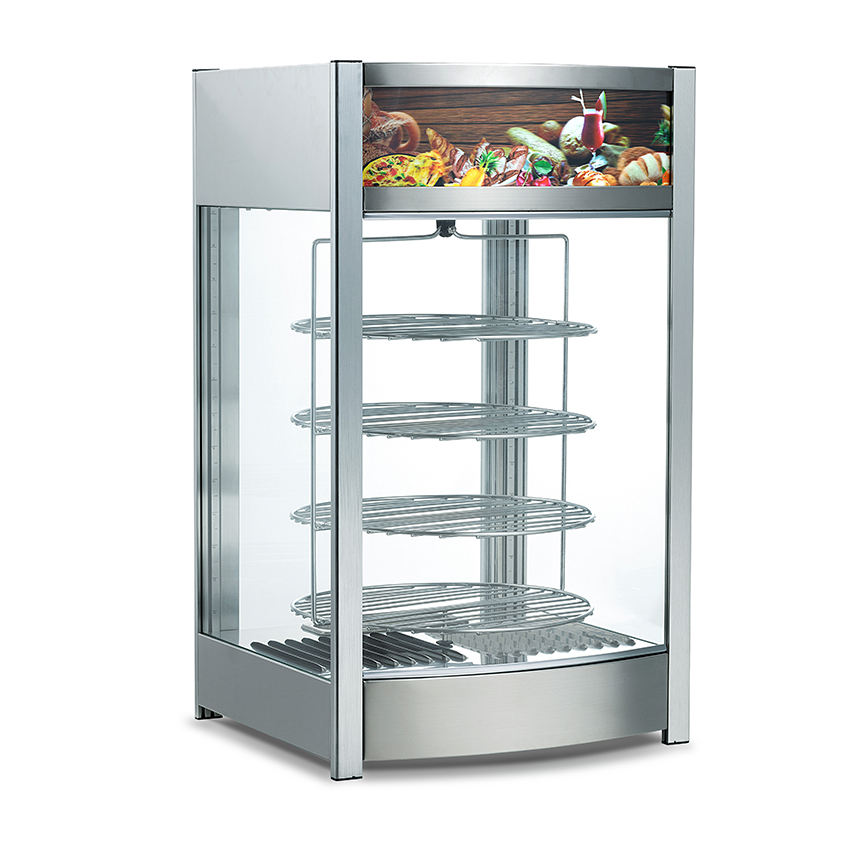
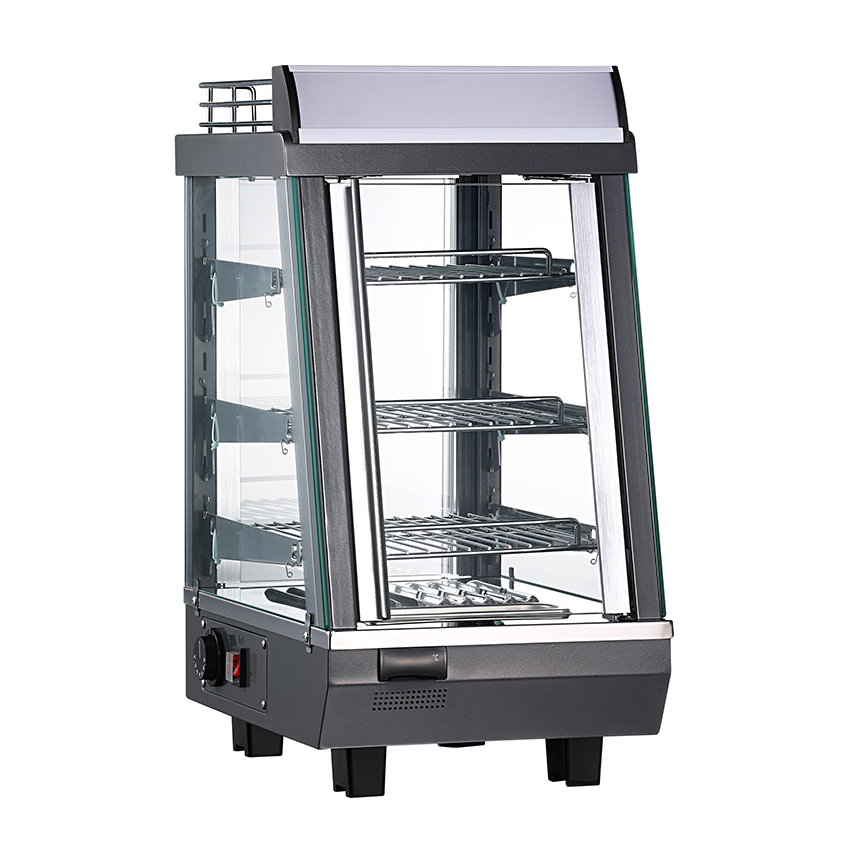
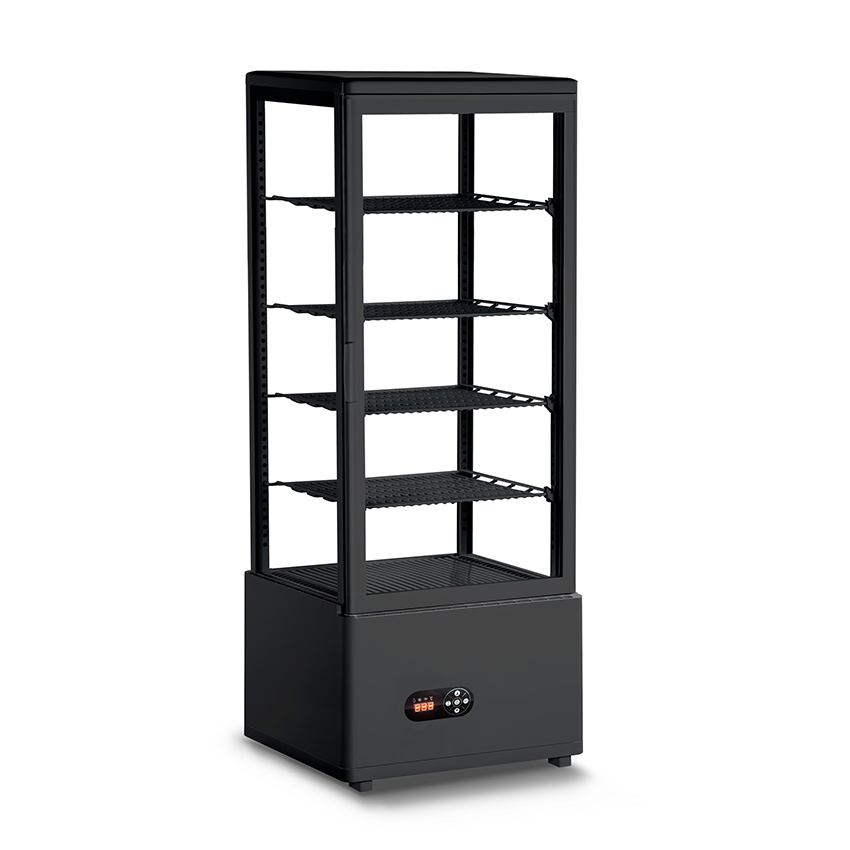
The multi-product thermal insulation display cabinet has various sizes, elegant appearance and unique design. It ad...



You are standing behind a bakery counter when the service technician points to the aluminum nameplate on the back of the new refrigerated cake display cabinet. "R-290, 120 grams," he says. If you have bought commercial refrigeration before, you know this single line changes how the unit is installed, ventilated, and serviced. If you have never thought about it, the next sections will help you read a refrigerant label with confidence.
Content
Put simply, the refrigerant decides three things: how much energy the system uses, how safe it is around customers and staff, and whether the equipment can still be legally sold, operated, and recharged over its working life. The last point increasingly drives purchasing decisions. The Kigali Amendment to the Montreal Protocol commits nearly every country to cut the production and consumption of hydrofluorocarbon (HFC) refrigerants, and regional laws such as the EU F-gas Regulation 2024/573 and the U.S. AIM Act turn those commitments into enforceable deadlines. Equipment charged with a high-GWP refrigerant today may be expensive to recharge in five years.
When you compare refrigerants, five parameters matter:
Nearly every refrigerant in commercial refrigeration belongs to one of five families. Their history is the history of cooling regulations.
Chlorofluorocarbons (CFCs) such as R-12 powered early refrigerators and car air conditioners, but their chlorine destroyed stratospheric ozone, so the 1987 Montreal Protocol banned CFC production globally. Hydrochlorofluorocarbons (HCFCs) such as R-22 served as the transition: they still contain chlorine but break down faster in the lower atmosphere. R-22 remains in older commercial systems, yet its production and import are being phased down, and by 2030 most developed countries allow only reclaimed R-22 for servicing.
Hydrofluorocarbons replaced CFCs and HCFCs in the 1990s and 2000s. They contain no chlorine, so their ODP is zero, but most are potent greenhouse gases: R-134a has a GWP of 1430, R-410A about 2088, and R-404A about 3922. Under the Kigali Amendment, HFC consumption is cut in fixed steps. The reduction is not an overnight ban, but quotas make virgin refrigerant scarcer and more expensive each year, which reshapes the new equipment manufacturers are willing to build.
Hydrofluoroolefins (HFOs) are the newest synthetic family. They decompose quickly in the atmosphere, which gives very low GWP values: R-1234yf is about 4, and blends such as R-454B and R-454C sit at 466 and 148 respectively. HFOs are not completely impact-free, but they behave much like HFCs, so manufacturers can adapt existing designs with fewer changes. The trade-off is mild flammability: most HFOs are rated A2L.
Natural refrigerants already exist in the environment. Ammonia (R-717) has served industrial cold storage for more than a century with a GWP of zero and excellent efficiency, but it is toxic and needs a ventilated machine room. Carbon dioxide (R-744) works at very high pressure with a GWP of 1 and dominates supermarket transcritical systems. Hydrocarbons — propane (R-290) and isobutane (R-600a) — have a GWP of about 3 and offer exceptional thermodynamic performance. Their growth in small sealed systems is one of the clearest trends in commercial refrigeration: the charge is small enough to be safe under product standards such as IEC 60335-2-89, even though the class is flammable.
ASHRAE Standard 34 assigns every refrigerant a two-part class. The letter indicates toxicity — A for lower toxicity, B for higher — and the digit indicates flammability: 1 for no flame propagation, 2L for mildly flammable with a low burning velocity, 2 for flammable, and 3 for highly flammable. A1 refrigerants dominated the market for decades; today the shift is toward A2L synthetics and A3 natural hydrocarbons.
| Class | Description | Common examples | Typical applications |
|---|---|---|---|
| A1 | Lower toxicity, no flame propagation | R-134a, R-410A, R-448A | Chillers, older display cabinets, AC units |
| A2L | Lower toxicity, mildly flammable | R-454B, R-454C, R-1234yf | New AC systems, some retail refrigeration |
| A3 | Lower toxicity, highly flammable | R-290, R-600a | Modern sealed display cabinets, bottle coolers |
For a foodservice operator the consequence is simple: A1 units install next to an oven without special ventilation, A2L units may need a larger machine compartment, and A3 units rely on a sealed system with a limited charge. The safety class is, in effect, the installation handbook.
For commercial cooling equipment, GWP is the most useful headline number. The chart below shows common refrigerants on a linear scale; the gap between an old HFC blend and a natural hydrocarbon is not a step but a thousandfold drop.
Figure 1. GWP of common refrigerants (CO2 = 1), 100-year values used in the EU F-gas Regulation 2024/573.
| Refrigerant | Family | GWP | ODP | Safety | Typical use |
|---|---|---|---|---|---|
| R-134a | HFC | 1430 | 0 | A1 | Chillers, older display cases |
| R-410A | HFC blend | 2088 | 0 | A1 | Residential and light commercial AC |
| R-22 | HCFC | 1810 | 0.05 | A1 | Older AC and medium-temperature systems |
| R-32 | HFC | 675 | 0 | A2L | New AC units, some retail cases |
| R-454B | HFO blend | 466 | 0 | A2L | Next-generation AC and condensing units |
| R-404A | HFC blend | 3922 | 0 | A1 | Older freezer and low-temperature equipment |
| R-290 | Natural hydrocarbon | 3 | 0 | A3 | Modern plug-in display cabinets |
| R-600a | Natural hydrocarbon | 3 | 0 | A3 | Household fridges, small beverage coolers |
| R-744 | Natural CO2 | 1 | 0 | A1 | Supermarket transcritical systems |
Because total emissions depend on how much high-GWP gas a country can place on the market, the schedule below shows the compliance pressure on anyone buying cooling equipment in Europe.
Figure 2. EU F-gas Regulation 2024/573 HFC phase-down schedule, percentage of the 2015 baseline.
A full comparison also has to balance environment, safety, and cost. The radar below scores three realistic options for a small display case; the values are relative and indicative.
Figure 3. Indicative comparison of three refrigerants for a small commercial system.
To see how a refrigerant travels through a machine, follow the colored circuit in the simplified diagram below: red is the hot gas from the compressor, orange the liquid line, blue the low-pressure line after the expansion valve, and green the suction line back to the compressor.
Figure 4. Simplified vapor-compression circuit in a plug-in refrigerated display cabinet.
The practical takeaway for a buyer is simple. Before ordering any refrigerated display cabinet, check three lines on the spec sheet: refrigerant type, charge quantity, and safety class. Across Europe and many export markets, newly manufactured plug-in display cabinets increasingly use R-290 or R-600a, because these refrigerants combine a GWP of about 3 with good energy efficiency at small charge sizes. A modest propane charge inside a hermetically sealed loop removes most of the compliance risk an HFC refrigerant would create over the next ten years.
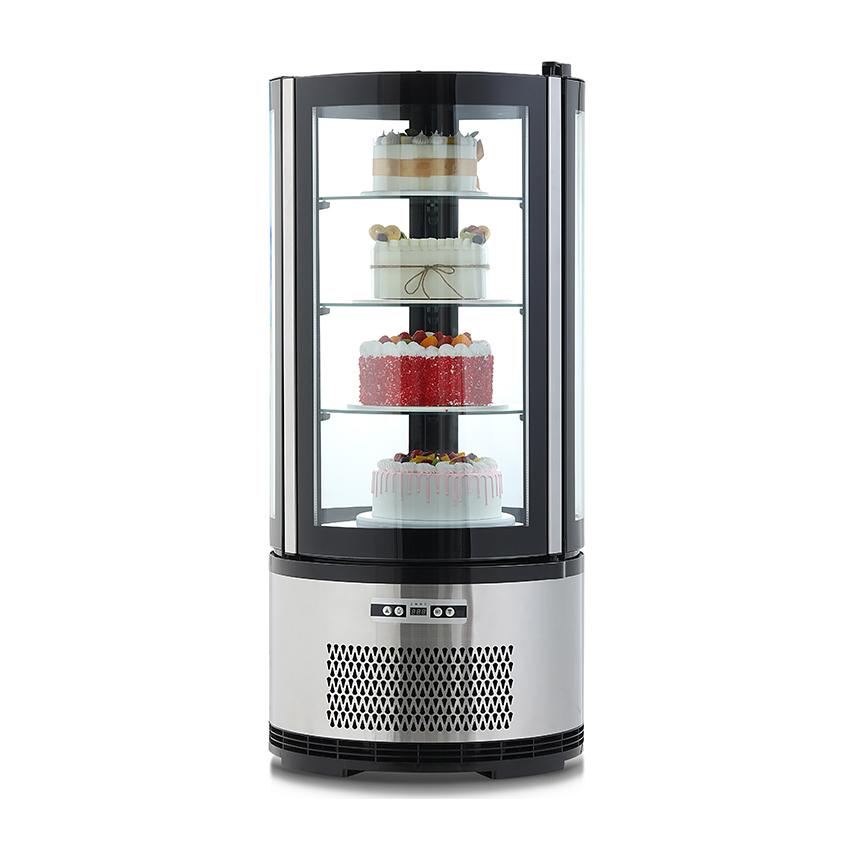
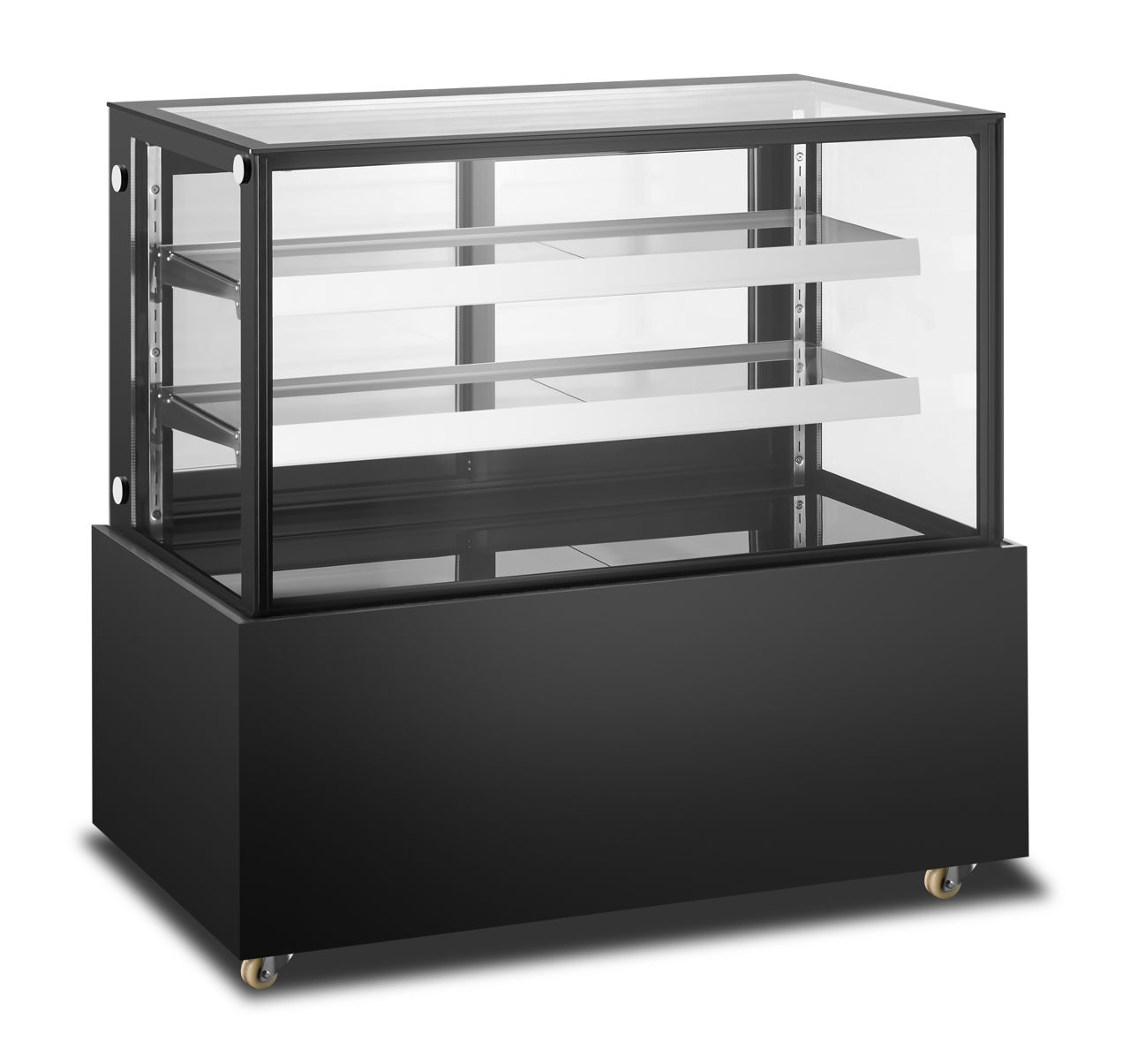
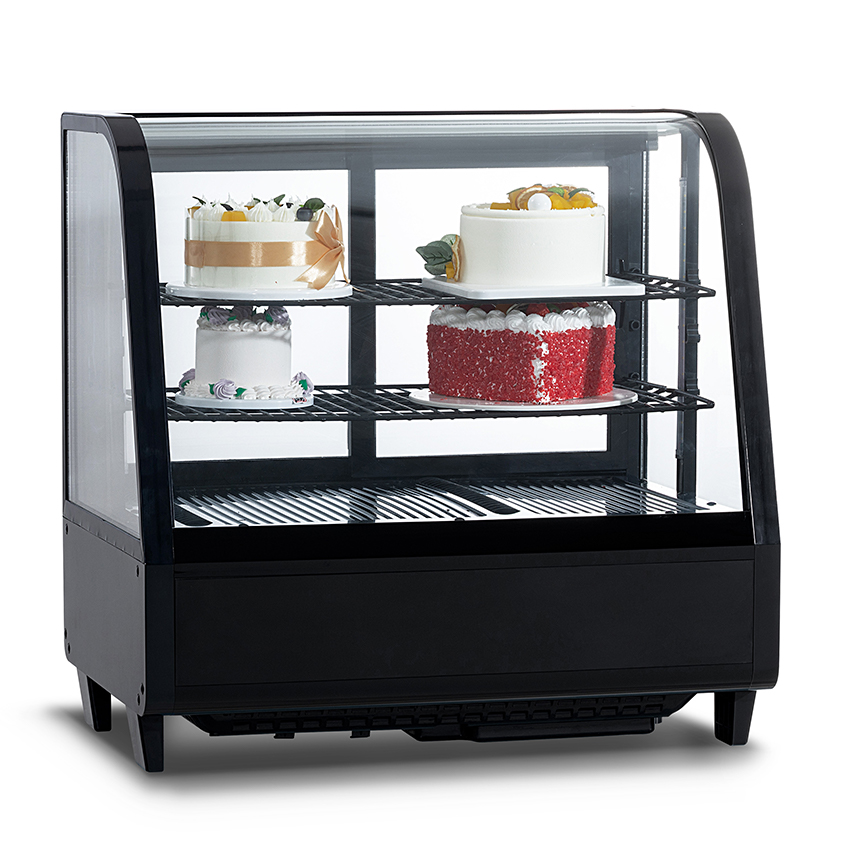 Self-contained cake display cabinet with low-GWP refrigerantThis refrigerated cake display unit uses sealed R-290 technology, making it a relevant choice for shops needing safe, energy-efficient food display while meeting modern refrigerant standards.View Product →
Propane is flammable, but the risk is managed at the design stage with sealed compressors, brazed connections, and charge limits defined by standards such as IEC 60335-2-89 and EN 378. That is why a self-contained cake display cabinet can safely use R-290 while customers stand a meter away. The same logic applies to counter-top refrigerated units, as long as the equipment is certified and the installation follows the instruction manual.
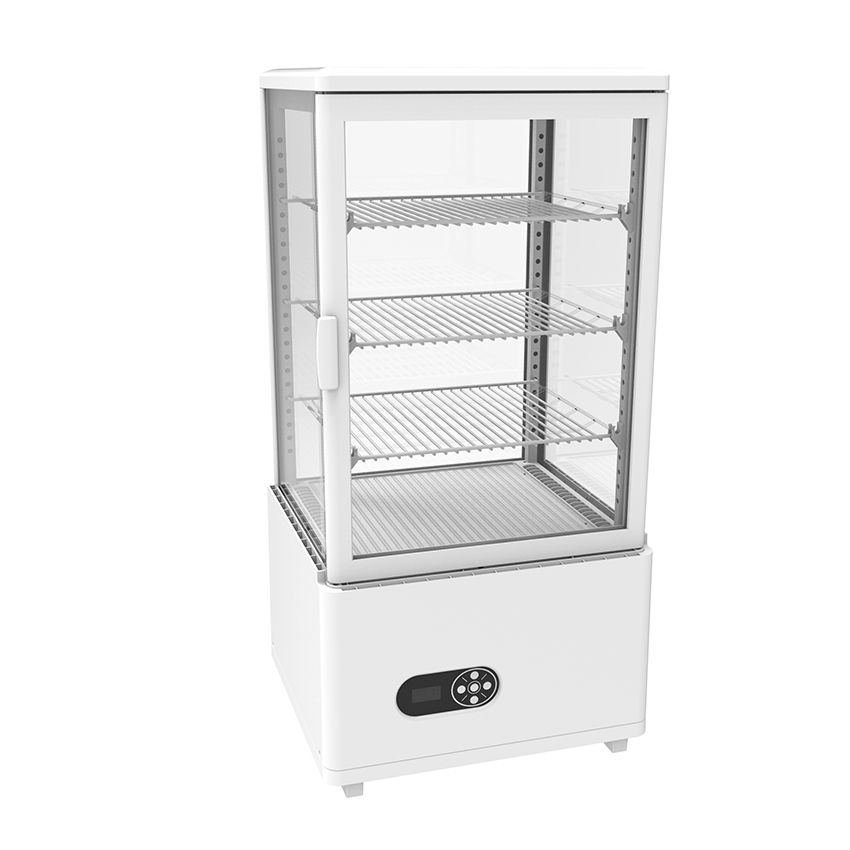 Low-noise tabletop refrigerated display cabinet for retail food displayThis compact, efficient tabletop unit offers low noise and configurable lighting and doors, suited for retail or catering spots where space and energy use matter.View Product →
If the cabinet will sit in a closed or poorly ventilated space, an A1 refrigerant may remain the safer local-code choice. If energy prices matter more, a low-GWP A2L or A3 unit usually posts a lower long-term operating cost. Refrigerant selection belongs at the specification stage, not after installation. For a step-by-step comparison of case dimensions and temperature performance, see our guide on how to choose a commercial refrigerated display cabinet.
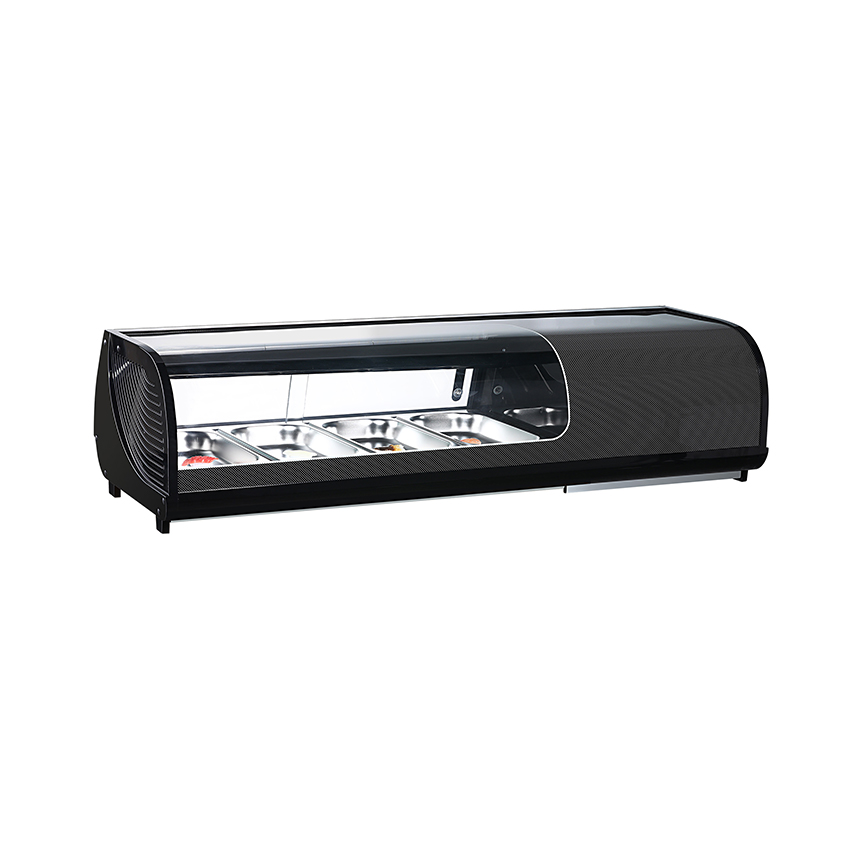
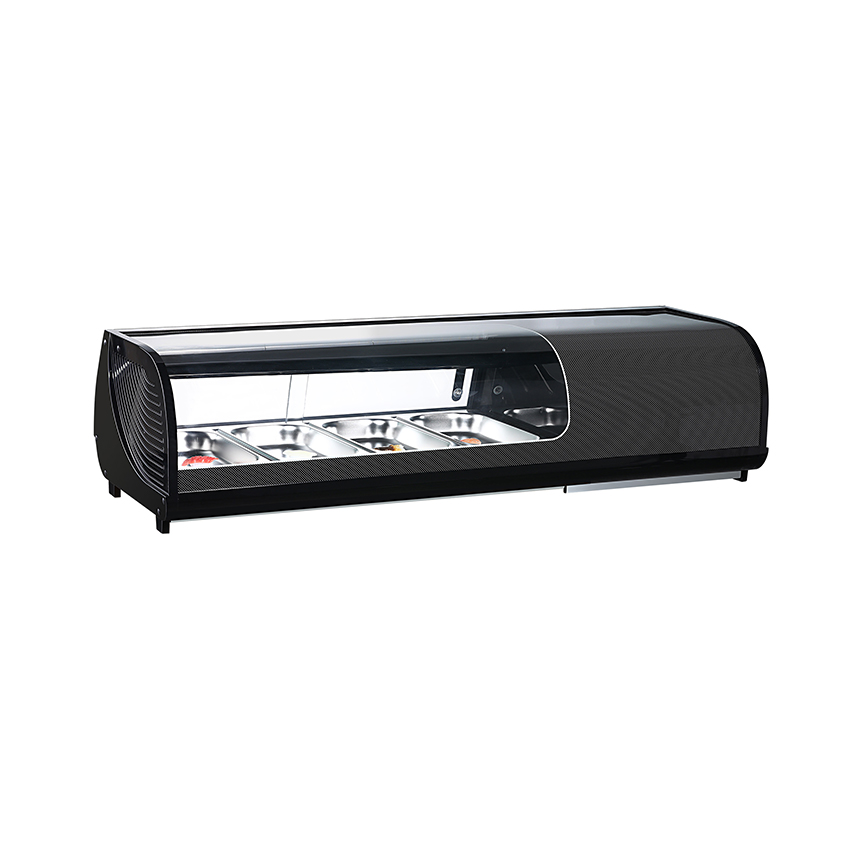 Sushi display cabinet with GN-compliant horizontal refrigerationThis horizontal sushi display cabinet supports multiple GN pans and steady temperature control, fitting sushi restaurants, supermarkets, or convenience stores needing flexible chilled storage.View Product →
Seafood operators see the same pattern in a sushi display cabinet: sealed systems, tight temperature control, and market-appropriate refrigerants. Reading the nameplate before signing the order avoids compliance surprises and rising service costs later.
Zhejiang Fuerj Electric Science And Technology Co., Ltd. was founded in 1997 and mainly produces electric heating products and refrigeration products such as freezers and cake showcases. The company covers an area of 110,000 square meters, with a construction area of 85,500 square meters. It has 650 employees, including 85 engineering and technical personnel; more than 160 employees hold a college degree or above, and 35% of the senior leadership team holds a college degree or above with corresponding professional titles. Annual output reaches 750,000 sets of various products. The products carry GS, CB, RoHS, UL, COC, and CCC certifications and are exported to more than 20 countries and regions in Europe, America, Asia, and Africa. You can browse the full product range on the company website.
Most newly built plug-in display cabinets in regulated markets use R-290 (propane) or R-600a (isobutane), both with a GWP of about 3. Older units may run on R-134a or R-404A.
Yes, when the system is hermetically sealed and the charge stays within the limits of IEC 60335-2-89 and EN 378. The refrigerant is flammable, but the sealed loop keeps it away from ignition sources.
Not immediately, but Kigali quotas tighten every year, so R-134a becomes costlier and harder to source. New equipment is moving to lower-GWP alternatives.
Check the serial plate on the back of the unit. It lists the refrigerant type, charge weight, design pressure, and electrical ratings.
Only with manufacturer approval. R-134a and R-290 need different compressors, expansion devices, and safety components.
ODP is ozone depletion potential; new refrigerants must have zero ODP. GWP is global warming potential relative to CO2, the value that drives phase-down rules.

Copyright © Zhejiang Fuerj Electric Science And Technology Co., Ltd. Rights Reserved. Food Showcase Display Manufacturer Fireplace Factory
